Wednesday, 9 October 2019

A testing interview with Julia


One of my favorite books is “The Beautiful Risk of Education” by Gert Biesta. The title concisely explains the essence of Finnish education - the willingness to take risks: no standard test until the end of their general upper secondary education is a risk; no supervision of teachers and teaching is a risk; the shortest school time is a risk; hiring a Chinese as International teacher assistant is also a risk. Among all the risks they are taking, students’ extra-curricular activities and how they spend their after-school time interests me most. Therefore, I had the idea of making a documentary about Finnish students’ after-school life. Naturally the International Studies (IS) students, whom I have been working with since August 2017 become my interviewees.

Julia was my first interviewee. She happened to sit at the corner doing her homework when Lenne (our cameraman) and I were ready to test our microphones and camera.  To be noted: it took us two months to get ready. J

Julia is a special girl. As she mentioned in the interview that everyone is special. However, she is really special to me and my teaching life in Kalajoki. This applies to the other students I am going to interview in the upcoming months. She doesn’t show much emotion, like her father, which you probably will notice if you have 18 mins to listen to the testing interview.

I was not a confident teacher when I first started my job in Kalajoki. I applied the international teacher assistant position when I was still living in Switzerland for my exchange study. Living in Switzerland with Leandra (my “host mother”) brought out the most confident me. She showed great compassion and respect to me and my culture background. However, all those confidences crashed when I stood in front of my Finnish students. Their faces were blank. They were indifferent to me and what I thought is important. There were so many times I had no idea whether I should continue my lesson plans or not.

There was one time after the IS lesson, Julia and her friend Johanna sitting under the stairs and waiting for the bus. I gathered all my courage and asked: Can I sit next to you? Can I ask you some questions? They accepted me and talked to me. They told me that they were waiting for their football training. They started to talk about their football club, and they shared their cookies with me. Though their faces were still blank but that’s the first time I felt connected to them.

Little by little, IS students started to talk to me more. I clearly remember once after the lesson, Julia and Santeri continued to talk to me. One of Julia’s friends asked Julia to leave, Julia said to her: “But I want to talk to Xiang…” I felt extremely flattered: WOW! She wanted to talk to me though I can’t tell anything from her face! She probably would never know how important that moment meant to my teaching life here.

If you want to know Julia more, I would highly recommend you listen to this short interview. Despite my grammatical mistakes, she answered all my questions profoundly and comprehensively. The interview covers the story of Julia establishing the first girl’s football team in her hometown together with her friends; connecting herself to the outside world through Erasmus+ projects; building the relationship between herself and the community she is growing up; preparing a gift for her father and so on. 

Click here to listen to the interview. Hope you enjoy listening to it!

Monday, 27 May 2019

Let's go picnic!!!


[It's a post talking about the picnic that happened on 15th of May.] 

I.S. 1 decided to go picnic together – a farewell party for Niko, who is going to leave Kalajoki and join Oulu ice hockey team. Xiang believes that creating different learning spaces can inspire dynamical communications, hence she is more than willing to go out with I.S. students. Everyone was going to bring their favorite snacks to share. Unfortunately, but not surprisingly (smile), one hour before we left for the park, Niko said that he couldn’t come because he was sick. But Johanna had made a mega-fine cake with mega-delicate decoration on top for him!!!!!!

Cake made by Johana!

So, we changed our plan to stop by Niko’s home before heading to the park! Xiang also cancelled her “treasure hunting” game which was planned on their way from lukio to the park. (Xiang knows that she would be too flexible to survive in German. Luckily that she is in Finland. She often changes her plans when students give their suggestions. Fortunately, her students always respect her decision when she has to face many different suggestions, which greatly saves her life.) 

After having the delicious cake with Niko in front of the gate, we marched to Plassi Park. Sun shines in front of us and leads a bright way to the Park. On the way there, Xiang learned that she could do many things better, for instance: she should have known when to be inclusive and when to be exclusive in terms of creating the learning environment; she could have bought and brought a picnic cloth (but she is living a life under budget for her future dream, please do understand) … She also hopes that her students can learn their own lessons by talking to each other. 

Ready to have cake with Niko!

I.S. students are always the best. We sat in a circle and started to share our snacks and drinks. At the same time, they divided into 5 groups to discuss questions prepared by Xiang:
  1. Describe your favorite school day in the past one year. What made that day very special to you?
  2. Where do you look for inspirations (in terms of connecting your experiences, expectations, perspectives and strong desire to try something new)?
  3. Imagine you are running into a burning house to save a child. On the way to the child’s bedroom, you discovered that there is a Picasso on the wall. You could save and liquid that, use the 75 million dollars you get from that sale to save many more children than one. If you can only save one, Picasso or the baby? Tell us why.
  4. If you have the chance to design a classroom which is inspirational, connecting, and encouraging, what are the most 3 important things you would like to have?
  5. Are you currently obsessed with some book, TV series, Podcast, website, people etc. that you would like to recommend to the rest of us?


Here you may find our discussions:


The picnic lasted until the rest of us felt exhausted. :) It’s a beautiful day. 

We set up a new restaurant!!!


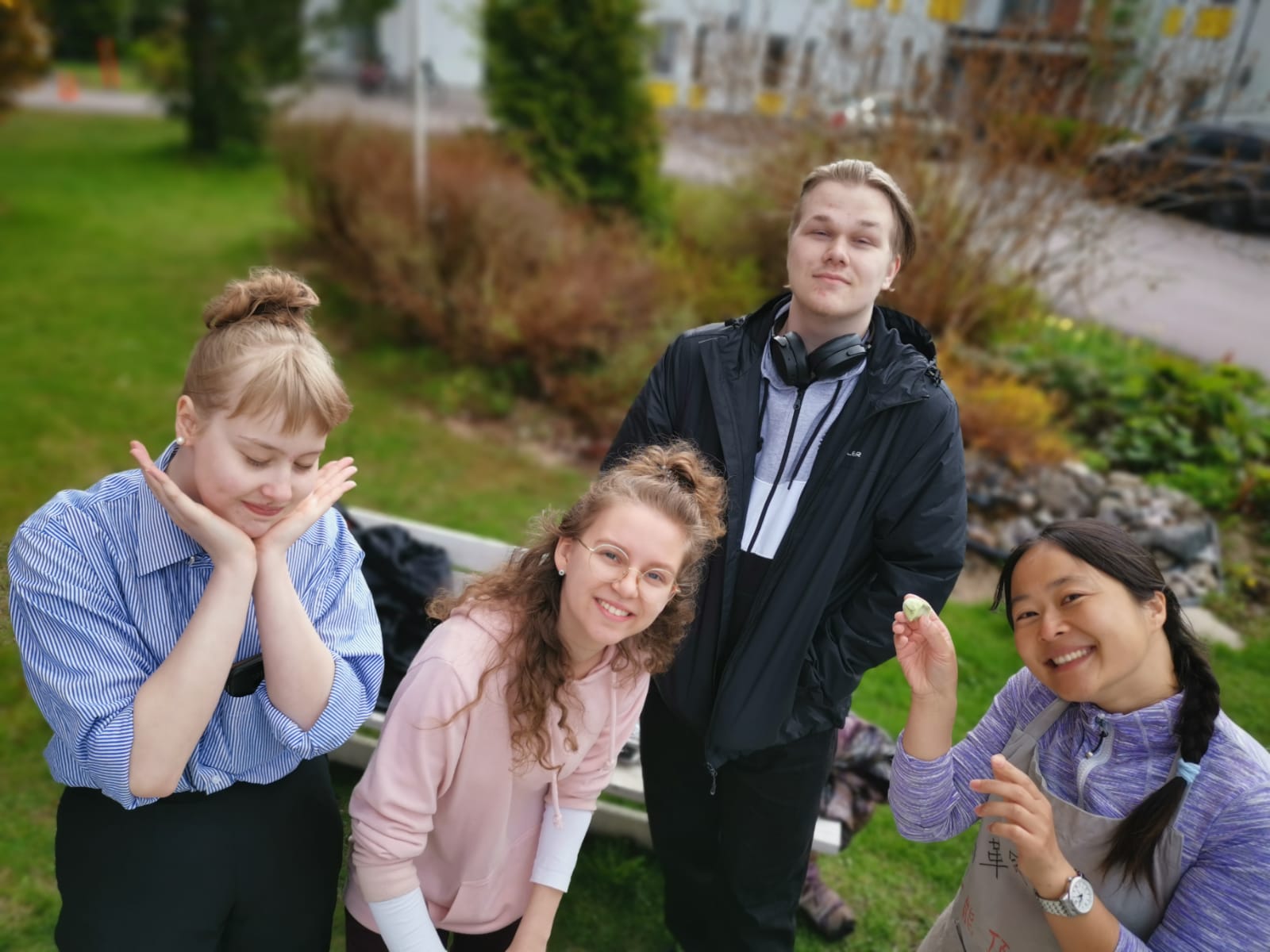
Three I.S. students, together with Xiang, took part in international pop-up restaurant and international afternoon, which was organized by City of Kalajoki and Kalajoki Christian College last Sunday. They planned to sell Chinese dumplings in hotpot style. It wasn’t well planned and organized, but they were still eager to set up the small business. The ideas of taking part in this pop-up restaurant event in hurry were:
  1. offering Chinese food experience to local people as authentic as possible;
  2. experiencing restaurant business by set it up from scratch; and
  3. seeing how much profit we can make so as to help with further planning, operation, pricing and marketing etc.
The net profit will go to their shared account for their Dublin trip in April 2020, if there is any. 

Xiang was excited and happy to see three lovely but tired face in front of Lukio! After a piece of biscuits without water, they quickly transformed into startup working mode (very Chinese Factory style). The restaurant was named after Xiang’s name. Alina and Taru started to design and make the signboard while Santeri was sent to shop for materials for hotpot. Dumplings preparation work had been done by Xiang in the early morning. 

Alina and Taru are making poster. Photo taken by Xiang

After making the signboard and collecting all the other needed supplies, they moved to Christian College and set up the booth in front of entrance. Alina and Taru were preparing the food ready for cooking. Santeri was assigned to sell, take the orders and run all kinds of errands at the same time. Xiang started to make dumplings. Taru soon joined the dumplings making production line.  It was quite amazing to see everything going smoothly, even though it was a bit cold when sun hid behind the big cloud and Santeri complained about his shoe ties occasionally. Aliz was also here helping her family with their Hungarian restaurant. Her constant pop-up to our restaurant booth brought us lots of happiness. 


Making food at the table. Photo provided by William

Happy faces. Photo provided by William
A glance of our menu on the poster! Photo provided by William

It was quite an enjoyable feeling to see local grannies, who are willing to try exotic food and young people, who brought their own containers for food. It also made us feel warm hearted when our own families and friends stopped-by and tried to support our “business”. Our next-stand Thai lady shared spring rolls to all of us and William bought us Ethiopian snack. 

After one and a half hours’ preparation and 3 hours’ hard working, we earned 20.55 euros. Xiang decided to give each helper 5 euros for lunch since she was too demanding during the work and didn’t take care of their wellbeing. She also bought the left-over food. In the end, only 10.15 euros will go into the bank account for Dublin trip. YEAH!!! 


It sounds like a joke but it’s a good experience, which was shared by everyone who participated. Whatever we experience, teaches us a lesson. More importantly, we learn our own lesson. 

Monday, 6 May 2019

Some thoughts about Finnish education after VESO Day

There are two things intertwined together, which deepens my understanding of how societal culture and values are embedded in educational practice. It also validates why I didn’t want to work at “education export” business between Finland and China. On the contrary, to understand the differences thoroughly and comprehensively gets more important and urgent.

One thing is, I finally went to get a new pair of glasses from a local glass shop. It’s quite expensive compared with the one I got in Beijing nearly 2 years ago. Unfortunately I stepped on it. :( The one I got in Beijing was about 25 euros. I got it the day I tested my eyesight. Cheap and quick! Though one of my friend who has his own glasses business in south China told me that there are lots of profits inside glass business. In general, there are always unbelievable profits in all kinds of products or services we are purchasing nowadays. In modern economy, “market” and “government” are two hands working together and making us accept the price of the commodities we paid for.

Therefore, I reluctantly accepted the price I paid for the new one in Kalajoki. It costed me 206 euros after a 35% discount. After one week, I got my new glasses! It took them one week to make one for me!! For those two reasons, I added much higher expectation to this new pair of glasses. I started to feel that it is pressing my backside of my right ear root and it is asymmetry. I started to feel headache and then I didn’t want to read anymore but watching Netflix. OMG! Life is much easier while watching Netflix. I don’t need to use my brain but laugh, cry, angry and laugh again…

The next day, I participated the VESO day with the other teachers from Kalajoki Lukio. Veso day is a teachers’ training day, as I understand. We were discussing how to build a better learning community for everyone in our Lukio. It turned out to be quite FUN and thought provoking!!! This is the other thing what I mentioned in the beginning. In spite of my inability to understand Finnish, they still welcomed me to join the training. In the first 2 hours group task, my group mates had to discuss the 10 topics with me in English and none of them are language teachers. Since I was taking the notes, they had to translate everything back to Finnish when we needed to transfer the notes onto google documents. In the last session, I even had a personal interpreter through the whole discussion.

What amazed me most in the VESO training are concepts as follows:
  • differences
  • differentiate learning contents, methods and evaluation for different learners
  • individuals
  • personalities
  • introvert and shy
  • students’ own preference
  • overcome teacher’s own bias
  • respect and appreciate
  • equality

Some questions raised by other teachers, which sound very interesting to me:
  • How to differentiate introvert and shy?
  • How to teach introvert/shy students who are willing to participate group work?
  • How to embrace different kinds of personalities other than teach only what we want to see?
  • How to connect the knowledge to real world, especially individual’s own reality and future?
  • What are the minimum/essential things we expect students to learn from this course so that some of they wouldn’t feel stressed?
  • How to raise students from their seats?
  • What are students’ learning methods and preferences?
  • Do we give good grade/feedback just because students look nicer?
  • How to work with difficult students, like perfectionist (How to teach enough is enough)?
  • How to bring students to their own potential?
  • How to link and bind the projects to normal school learning?
  • How to emphasize on locality, roots and history?

The emphasis on individuality and the support to each individual in Finnish school is quite beyond my understanding. I come from an extremely standardised social and educational system. In terms of education, there is only one way to evaluate nearly every student in the whole China: the annual national college entrance exam. Nowadays some provinces gain certain autonomous in the exams, which means students only need to compete within their own province. This exam is the baton of the whole 12 years schooling every Chinese student receives. Very tiny amount of people can bypass it if they are either genius or have a special father. If you don’t fit into this system, it would be your own problem. It’s a crude “survival of the fittest” competition. Most of us started the competition when our mother decided who she was going to marry with. That’s one of the reason why marriage is heavily interfered in order to create the best surroundings for the next generation.    

Whereas, Finland is creating a system in which everyone works towards the best of themselves. In addition, they even provide support to perfectionism students in case they stress themselves out. Teachers are struggling to teach students what “enough” is. Oikesti???!!!

 Let’s go back to talk about my new glasses for a bit.

I told my colleagues that I feel uncomfortable with my “expensive” new pair of glasses. They all said back to me: Go back to the store and let them fix for you. But I “feel” uncomfortable. How can I valid my “feelings”. They answered: Just go and tell them your feeling.

I went. The shop assistant helped. I came back again and I still feel a bit strange. My dearest colleagues gave their experiences of how many times they have visited the stores to fix their own so as to encourage me go back again whenever I feel uncomfortable. I questioned: Won’t they get annoyed by me? To what extent it fits me then? They laughed and said: Until you feel ok with it. You paid for the services and they will help you.

I am puzzled. I did pay for the product and the service. But the service is so subjective that I am not even sure what is “good enough” to me. It is so difficult compared with my experience in China that I paid for the product and then I get used to what I paid for. People would think I am weird if I complained and they would argue that: why don’t you buy the expensive one from a fancy shop. You get what you paid for.

The puzzling I have here resonates with the feeling when I listened to my colleagues talking about differences and individualities among students. How do the students know their levels of learning? How much can teachers be sure that students feel stressed, therefore, we shouldn’t push them go further? If we don’t push further, how much his or her potential could be reached then? How much should a teacher trust students’ feelings? Meanwhile, to what extent students are sure of their own feelings??? Who is the person to decide “enough is enough” for students then?

The questions are not aimed to be answered but used to guide myself on becoming a teacher, as well as a learner in a very different community and ever-changing century. 
 
The beautiful scenery from where we had the VESO Day!

Tuesday, 16 April 2019

A piece of reflection of the project "Know Thyself"

I watched Joshua: Teenager vs. Superpower on the Saturday after “Know Thyself” project. One of the students in the project said to me that she learned a lot about China and Hong Kong after watching it. I said to her that the content is probably one-sided, which I believe she is intelligent enough to know. However, I still had to say it out: to remind myself. 

I hold myself tightly while watching it, but tears still came out without any notice. It’s a documentary about democracy vs. one-party government,  pre-screening of candidates voting vs. true voting, young vs. old, history vs. present, freedom vs. brainwashing, borders vs. free competition, and the identities (who we are?)… Instagram was blocked in mainland China by the “Great Firewall of China” since the start of the Umbrella Movement initiated by Joshua Wong in Hong Kong in 2014. That’s exactly the time when I began to visit the information outside of the Firewall. Before that breaking point, I worked in a company which had its own VPN to access the outside world but I had no intention to know what was happening there. People need certain strong and special influential factors and opportunities to break their normal world. Otherwise, why bother??? We are safe and cozy in our own bubbles. :)

After living abroad, I realized that it can be extremely beautiful to flee away from the previous safe and cozy bubble. It first makes you suffer from cognitive dissonance but it also makes you understand “who you are” from a brand new perspective. That’s the premier reason why I started this one week project “Know Thyself” with high school students here. It’s so easy for me to notice the differences by simply living in another country. However, how to bring the differences to the students, who live in such a homogeneous town in Northern Finland? Are they willing and ready to recognize, embrace and reflect on the differences? It’s one week of trial to my assumptions and plans. Now it’s officially ended. 

It was difficult to divert my thoughts away from what the students said to me during that week. I have learned so much of them and from them. 
  1. friendship is one of the contributory factors to join, stay or quit a new course 
  2. friendship is a great compensation to boredom
  3. friendship is fluent but limited as well (I would imagine that if the students were not from Merenojan Koulu, it would be a bit challenging for them to join in the somehow closed/ groups. It would be great if we encourage a more integrated/inclusive culture when the fresh lukio students starting their school)
  4. learning emerges easier and quicker when students “teach” about their own passions (Teenagers have their own languages; students enjoy learning from each other)
  5. it’s much easier to build learning on the “real” experience. As a teacher, I should do my best to offer the experience to my students(hot pot, tea and cheese taste, campfire are positive examples from this project)
  6. it’s necessary to put students into different learning environments, which creates different opportunities for students talk to others  
  7. we tend to look for similarities but avoid the differences (however I believe, if we don’t appreciate the differences, then learning can only stay on the superficial level)
  8. we are not ready to confront different opinions. A good example is that we can’t afford a deep discussion about Coco Chanel or Jordan Peterson (As a teacher, I lack of the skills to conduct a profound discussion on these controversial topics)
  9. students are afraid to be judged by the others (“Judgement” itself should have be integrated into some courses. Where is it come from? Why are we so vulnerable in front of it? How to overcome it?)

I was bothered by the fact that I am not ready to have further discussion on the controversial topics, which makes me a less competent teacher. I thought of Coco Chanel and the awkward discussion we had after one of students introduced her to the rest of us. Some other students reminded us that she was a lover of Nazi officer or something like that. I know nothing about Coco Chanel but Chanel as a brand. Still, I said: it must be not that easy. I know myself and I know how complicated people and things can be. Boys in the group turned up their nose and argued: but help Nazi to kill Jews?? I was put into silent. One thing I believe is that: the situation must be more complicated than we thought/knew, or willing to know. Next day, after students talked about their complicated fathers, I brought up Jordan Peterson’s podcast, in which I think he explained well about how we humans tend to simplify the complicated world. (I like complication, by the way.) Again, another controversial person… And again, I couldn’t host the topic longer or deeper.

After watching Joshua and organizing those thoughts in my head during the weekend, I decided to watch The Pianist, a film I watched once when I was in China many years ago. Didn’t remember anything special, to be honest. I even visited Warsaw and Kraków two years ago but I couldn’t relate as much as my two other friends. I feel more sad when reading the historical stories about 20th century China, which exactly epitomized the narrow-minded humans: we can only understand things to which we have the attachment.  

I was disgusted by how the nazi treated Jews in the movie and I kept wondering: what made Coco do it? What I would do if I lived in that situation? Would I sacrifice my life and my family to help Jews? If I was a Jew, would I fight back or choose to die dignified? What I have done so far while reading western media talking about the Xinjiang re-education camp? I did nothing! Nothing…Nothing… 

The curiosity drove me to read Hal Vaughan’s “Sleeping with the Enemy: Coco Chanel’s Secret War”. It was stunning for me to read the Excerpt as follows:
We also know that at the turn of the twentieth century, Catholic institutions such as Aubazine indoctrinated Catholic youth to loathe Jews. Chanel was no exception. She was often given to anti-Semitic outbursts… When the conversation turned to how new fashion boutiques were springing up like mushrooms in Paris, Chanel declared, “I only fear Jews and Chinese; and the Jews more than the Chinese.” 
We are so much moulded by the environment and culture we grow up, aren’t we? To understand differences across time and space needs a lot of effort to put people back to the contexts, to understand the complexity. Unfortunately, we often simplify things by only looking at the results or by categorizing them. Next step, we make judgements, form tribes and build walls. However, can we, as normal human beings, take on the complexities? In other words, is it necessary for us to understand the complicated situations across history and globe? If the answer is yes, how to prepare ourselves and young students to go through the upset reality laden with conflicts? 

I am not here to ask for the answers. But I appreciate I have the chance to look for the answers from working with the students here. Great thanks to those who have spent that special week with me.

With love~

Campfire is on!

A collection of the photos~

Someone is hosting a tea ceremony!

Hot Pot in Kalajoki!!!

Wednesday, 20 March 2019

Life exams


“It was the best of time, it was the worst of times” Charles Dickens couldn't have imagined that the first line of his classic “A tale of two cities” would somehow come to describe my time during my final weeks of high school but nonetheless his sentiment seems very true to me now.

In some ways my final high school exams came too late, I felt like I was already prepared for the world, I was working, making money and living my life how, as I thought, an adult should. I was still staying at my childhood home, but I was living away and embraced in the independence of financial gain but kept safe in the shadow of responsibility. My final year exams and those months of stress, fun, tiredness, fatigue, endurance, suffering, neglect, joy, regret, energy, love, hate, annoyance and acceptance all seems fresh in my and pull at my soul bringing me back to a time of utter destruction and ultimate redemption.

I learned a lot. Perhaps much of it is lost in time but now as I am working in education once more I feel that it makes me a better educator to remember those times of exams, the pressure that I felt and the sense of foreboding of the result. But also of the friends I had, tempered by the stress and made stronger by the pressure. At this point in my life I can firmly say that those exams and those results have not defined me and I hope that any student reading this now can take some solace in my words.

The knowledge you learn during your time, your ability to learn, to take in information, to analyse and to deduce are only part of your educational path. In the Kalajoen Lukio I am proud to say that there is a focus on providing those other skills that cant be tested on a paper or solved as an equation, teamwork, empathy, understanding, collaboration, creativity are all needed in the realities of daily life and in order to educate these lessons a school needs to provide the means. The lukio focuses on providing students avenues to explore these skills through different projects, creative productions, international cooperation and projecting a sense of trust among our students.

I have been part of a number of interview panels in my time and even though the candidates grades are important and the time and effort made to achieve them in itself an indication of the candidates abilities, as an interviewer, I am drawn to what achievements they have accomplished, how the solved a problem, created a solution and worked as part of team. The grades are part of the overall picture and so remember to balance that expectation of perfection with the results of your tasks.

A Persian Sufi poet once wrote a fable about a King who asked his wisest men to provide him with a gift that would make him happy when he sad, but sad when he was happy. The wise men thought about this and made for the king a gold ring with the words, “ This too shall pass” engraved on it.

For those of you going through this challenging time just remember that this time will pass and soon another opportunity will come your way and you will be a little stronger for it. If its not challenging its not changing!

Willz

Friday, 15 February 2019

Tonight, we are young! -- To vanhat2019


First time seeing Vanhat was a beautiful accident. It happened when I was visiting Pateniemi Koulu. At some point during that day, everyone came and gathered in front of the gym hall and some teacher told me that upper secondary school students were going to dance for us. Indeed, it was an eye-opening performance. My mouth was opening the whole time as well! (I am from Aisa and I didn’t even familiar with the very popular American Prom culture.) I got to know that: this dance is a celebration of when the second-year students become the seniors of the school. The third-year students just left school the day before, on the “penkkarit” day.

Overall, that vanhat thing left an interesting impression on me. Soon after that, I left Finland and didn’t think further about it.

Nevertheless, vanhat became one of the most frequently mentioned topics from the very beginning of our spring semester. I thought that all second-year students learned the dance during their PE lessons when I first watched the vanhat one year ago. After working here, I got a peek into this very sophisticated thing. What do I mean by “sophisticated”?

Reason 1: Principal asked me to leave the vanhat dress advertisements on the school board, but we cleaned many other ads last September. She said students would need those. That surprised me.
Reason 2: Some students won’t participate because the dress is expensive and vanhat is the only situation where you wear it, specifically for girls.
Reason 3: Students plan to find the partner when their upper secondary school day starts. Vanhat is the Princess’s Day to many girls and it is not easy for every one of them to find the Prince.
Reason 4: Students feel “stressed” with the dancing practice and hairdressing before the ball happens, because they want everything to be perfect on that day.
Reason 5: There are some students deciding not to take part in this Princess’s Day.

Here you can also listen to two of our second-year students discussing about how the preparation of vanhat added stress to their life.

With all these “sophisticated” pre-judgement, I came to watch this year’s vanhat. I didn’t enjoy as much as someone who sat next me and have watched vanhat many years and still feels hyper-exciting. (It's William, of course!) I know there must be something wrong with me or my such biased information that I couldn’t focus on the moment. I was thinking too much about those who didn’t take part in the ball.

I decided to watch it again! The last dance of today was meant for participants’ families and friends. The atmosphere of the audience area was already different. When the dance started, I found so many happy faces on the stage. Those Finnish students were smiling! Some of them smiled so hard that I even smiled. They were also interacting with each other! Of course, they would be interacting with or even “falling in love with” their partners because the ball created a special moment where they see the best of their partners. It’s a fairy tale moment and it’s surreal. But life is so monotonous that we need that kind of moment, don’t we? If not here, there must be somewhere else. And those students who didn’t take part in this, they will certainly find that moment somewhere else.

I looked at the happy dancers, suddenly I realized how amazing this whole education system is. I was very much bothered when I first entered one classroom, or later most classrooms in upper secondary schools, that girls and boys were sitting away from each other. I tried to mingle them. How ridiculous I was when I think back now. This system already has the opportunity for their students to mingle with each other: the very elegant dancing party. The moment students decide to attend vanhat, they started “playing the game” with the whole group already. It’s a long-term game. When you finish this game, you are mature enough to be the seniors in school. In Finnish, they called it “kypsä”. “Kypsä” also suits for students who made the decision not to attend the ball; students who made their choices to be a Princess or Prince and the students who I have neglected due to my ignorance.

The highlight of the ball was the last part when participants’ families and friends were invited to dance on the stage. A celebration for all!


To sum up: these two days are very special and extremely important for me to understand Finnish culture, which is embedded in our school life as well. Kalajoki and the people living here, win my heart. Cheers! May your life never end with celebrations! Hilarious or elegant.

I said to my colleagues in the staff room that I wish I was 5 years old so that I could experience the awesome education system. How beautiful it would be. :)